Hong Kong Apostille for Financial Firms Enter Mainland China
For Hong Kong financial institutions planning to enter Mainland China—whether through establishing a subsidiary, acquiring a Mainland asset manager, forming a joint venture, or conducting cross-border regulated activities—proper document authentication is not administrative formality. It is a regulatory requirement.
Incomplete or improperly apostilled corporate documents frequently delay CSRC approvals, AMAC registrations, and SAFE capital filings. While Hong Kong operates under the Hague Apostille Convention, Mainland China applies specific recognition arrangements to Hong Kong public documents. This guide explains how Hong Kong Apostille functions within China financial expansion, what documents are required, and how senior management can mitigate regulatory risk.
What Is an Apostille Under the Hague Convention?
Schedule 5 to the Securities and Futures Ordinance (Cap. 571) (SFO) specifies 13 types of regulated activity, each with a detailed statutory definition. Carrying on any of these activities in Hong Kong—or actively marketing such services into Hong Kong—may trigger licensing or registration obligations.
An Apostille is a certification issued under the 1961 Hague Convention Abolishing the Requirement of Legalisation for Foreign Public Documents. Its purpose is to simplify cross-border document authentication between member jurisdictions.
Instead of going through multiple consular legalization steps, a single Apostille certificate confirms:
- The authenticity of the signature
- The capacity of the signatory
- The validity of the official seal
Is Hong Kong Covered by the Hague Apostille Convention?
Yes. Hong Kong is a participating jurisdiction under the Hague Apostille Convention.
The designated authority issuing a Hong Kong Apostille is the High Court of Hong Kong – Apostille Service Office. Only the High Court may issue a valid Hong Kong High Court Apostille.
Do Hong Kong Financial Firms Need Apostille for Mainland China?
Yes. Since Mainland China formally acceded to the Hague Apostille Convention in 2023, Hong Kong-issued public documents intended for use in Mainland China now require Apostille instead of traditional consular legalization.
However, simplification does not remove regulatory scrutiny. Mainland authorities—including CSRC, AMR, SAFE, and local financial regulators—still require properly authenticated corporate documents.
Why Financial Institutions Face Higher Scrutiny
Financial services firms encounter enhanced review due to:
- SFC licensing status
- Cross-border capital supervision
- AML / CFT requirements
- CSRC prudential review
- SAFE foreign exchange controls
When a Hong Kong asset manager enters Mainland through QFLP, WFOE advisory, or joint venture structures, regulators will examine:
- Corporate standing
- Shareholding transparency
- Board authorization
- Regulatory licensing proof
- Ultimate beneficial ownership
Apostille ensures formal authenticity—but it does not cure substantive compliance gaps.
When Do Hong Kong Financial Firms Require Apostille for Mainland China?
Apostille is commonly required in the following regulated scenarios:
- Establishing a Mainland subsidiary (e.g., private fund manager, WFOE)
- Acquiring a Mainland asset management company (M&A)
- Filing with CSRC or local financial regulators
- Capital injection or equity restructuring
- Cross-border fund distribution arrangements
- Appointing authorized Mainland representatives
- Litigation or arbitration proceedings in Mainland courts
In regulated sectors, document authentication errors can directly impact approval timelines.
Required Documents for Hong Kong Apostille in China Financial Expansion
Corporate Documents
- Certificate of Incorporation
- Business Registration Certificate
- Certificate of Continuing Registration
- Articles of Association
- Board Resolutions approving Mainland expansion
- Register of Directors and Shareholders
For Companies Registry documents, a recent company search extract (issued within 3 working days) is often required prior to Apostille issuance.
Regulatory & Licensing Documents
Where the applicant is an SFC-licensed corporation, PRC regulators may require:
- SFC Licence Certificate
- Responsible Officer approval evidence
- AML/KYC policy declarations
- Regulatory compliance undertakings
These documents demonstrate regulatory standing and operational legitimacy.
Transaction-Specific Documents
Depending on structure, additional documents may include:
- Power of Attorney for Mainland representatives
- Fund management agreements
- Custodian or trustee agreements
- Capital contribution confirmations
- Cross-border advisory contracts
Each must be properly notarized (if private document) prior to Apostille.
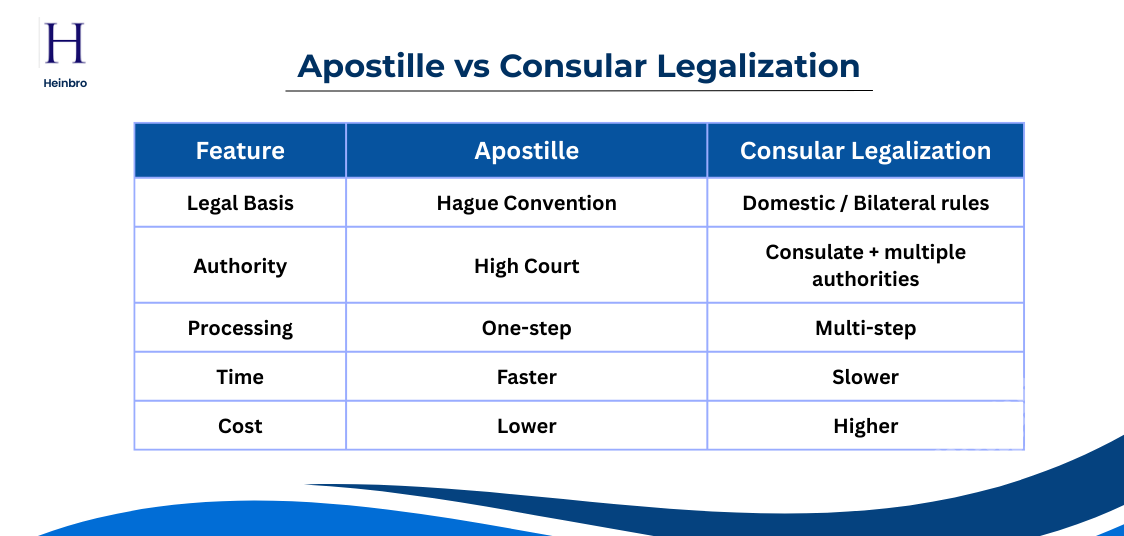
What Is the Difference Between Apostille and Consular Legalization?
Understanding the difference is critical for compliance planning. Apostille applies when the destination country is a Hague Convention member. Consular Legalization applies when the destination country is NOT a Hague member. Failure to determine the correct route may lead to document rejection.
Hong Kong Apostille Procedure for Financial Firms
Step 1: Internal Regulatory Review
Before submission, confirm:
- Accuracy of document versions
- Board authorization validity
- Alignment with Mainland filing requirements
- Translation requirements (if applicable)
- Companies Registry documents require a recent company search printout
For regulated financial institutions, this internal review should be integrated into the transaction timetable or licensing submission schedule to avoid regulatory delays.
Step 2: Determine Whether Notarization Is Required
Public documents bearing official signatures generally do not require notarization before Apostille. Commercial documents and Power of Attorney must first be notarized by a Hong Kong Notary Public before submission to the High Court. Failure to notarize when required is one of the most common causes of rejection.
Step 3: Submission to the Hong Kong High Court Apostille Office
Apostille applications may be submitted in person at the High Court Registry, by post, or through the limited e-Apostille service (for digitally signed documents submitted by enrolled Notaries Public). The official fee is HK$125 per Apostille. Processing time is normally 2 working days, while overseas postal applications typically take around 2 weeks.
Step 4: Collection and Cross-Border Use
After Apostille, documents may need:
- Certified Chinese translation
- Additional supporting documents
- Alignment with PRC administrative requirements
Apostille confirms authenticity—but Mainland regulators still conduct substantive review.
Why Apostille Matters More for Financial Services Firms
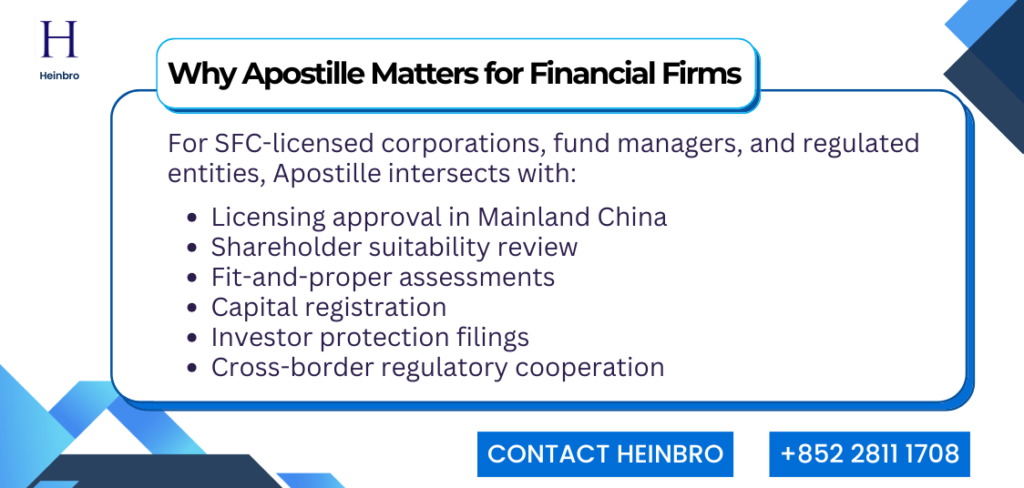
In regulated industries, document rejection can delay market entry, impact investor timelines, and affect commercial negotiations.
Case Example: Cross-Border M&A Transaction in Mainland China
An SFC-licensed asset management group in Hong Kong initiated an acquisition of a Mainland private fund management company. As part of the regulatory approval process, the Mainland authorities required authenticated Hong Kong corporate documentation, including:
- Certificate of Incorporation issued by the Hong Kong Companies Registry
- Board resolutions approving the acquisition
- Power of Attorney authorizing designated Mainland representatives
The Certificate of Incorporation was submitted for Apostille authentication by the High Court of Hong Kong. The board resolutions and Power of Attorney were first executed before a Hong Kong Notary Public and subsequently Apostilled by the High Court.
Following proper notarization and Apostille sequencing, the documents were accepted by the relevant Mainland authorities, and the M&A approval process proceeded without regulatory objection.
Certain business models, products, and operating arrangements raise additional SFC licensing considerations beyond the basic question of whether a regulated activity is carried on. The following guidance highlights common scenarios where firms frequently misunderstand their licensing obligations.
Managing Hong Kong Apostille with Regulatory Precision
For Hong Kong financial firms entering Mainland China, Apostille is not merely document certification—it is a gateway requirement for regulatory recognition. Whether structuring a Mainland subsidiary, acquiring a PRC asset manager, or expanding cross-border regulated activities, authentication must align with broader licensing and compliance strategy.
Heinbro combines deep regulatory expertise with hands-on operational support for financial services firms. As a one-stop compliance services provider for Hong Kong financial firms, Heinbro supports:
- Establishment (licensing and immigration)
- Ongoing operations (compliance, inspection support, training)
- Growth (recruitment and resourcing)
When your Hong Kong Apostille requirements intersect with Mainland China entry, licensing, or cross-border M&A, partnering with a firm that understands both document authentication and financial regulation ensures efficiency, risk control, and regulator-ready confidence.
Ensure your documents and your regulatory strategy move forward without delay. Get in touch with Heinbro at heinbro@heinbro.com or call +852 2811 1708 to arrange a free consultation.