Hong Kong VASP License Guide: Requirements & Application
Hong Kong is rapidly positioning itself as a global hub for digital assets and Web3 innovation. With the implementation of the Virtual Asset Service Provider (VASP) licensing regime under the SFC, crypto exchanges and digital asset platforms must obtain regulatory approval before operating in the market.
For founders, Web3 startups, and institutional crypto businesses, obtaining a Hong Kong VASP license is not only a regulatory requirement—it is also a strategic step toward building trust with investors, partners, and regulators. This guide explains the Hong Kong VASP license requirements, application process, compliance obligations, and key considerations for crypto businesses in 2026.
Do You Need a Hong Kong VASP License?
Businesses That Must Be Licensed
A Virtual Asset Service Provider (VASP) generally refers to an entity that conducts business involving virtual assets on behalf of clients. These activities typically include:
- Operating a virtual asset trading platform
- Facilitating crypto asset trading services
- Providing brokerage or intermediary services for digital assets
- Offering custody or safekeeping services for client virtual assets
Businesses that operate virtual asset trading platforms or provide virtual asset services may be required to obtain a license from the Securities and Futures Commission (SFC).
Licensing Triggers for VATP Operators
A license is generally required if a corporation:
- Carries on virtual asset trading activities in Hong Kong, or
- Actively markets such services to the Hong Kong public, whether from within Hong Kong or from overseas.
Corporations carrying on or actively marketing virtual asset services in Hong Kong must obtain a VA service license under the Anti-Money Laundering and Counter-Terrorist Financing Ordinance (AMLO).
Depending on the nature of the platform’s activities, operators may need to obtain licenses for the following regulated activities under the Securities and Futures Ordinance (SFO):
- Type 1 – Dealing in securities
- Type 7 – Providing automated trading services
What Is Platform Operator and Licensed Individuals?
The SFC licensing framework covers not only the platform operator but also individuals involved in the operation of the trading platform.
Platform Operators
The Platform Operator refers to the legal entity responsible for operating the virtual asset trading platform.
This entity must hold the corporate license and is responsible for:
- Ensuring regulatory compliance
- Maintaining internal control systems
- Managing platform operations and risks
Responsible Officers
Each licensed platform must appoint Responsible Officers (ROs) who are responsible for supervising regulated activities.
According to the licensing handbook:
- At least two Responsible Officers must be appointed
- At least one RO must be an executive director
- ROs must have sufficient authority within the organization
Responsible Officers play a critical role in ensuring the platform complies with all regulatory obligations.
Licensed Representatives
Individuals conducting regulated activities for the platform must obtain approval as licensed representatives.
Licensed representatives must:
- Meet fit and proper requirements
- Demonstrate competence and experience
- Operate under the supervision of Responsible Officers
Key Requirements for a Hong Kong VASP License
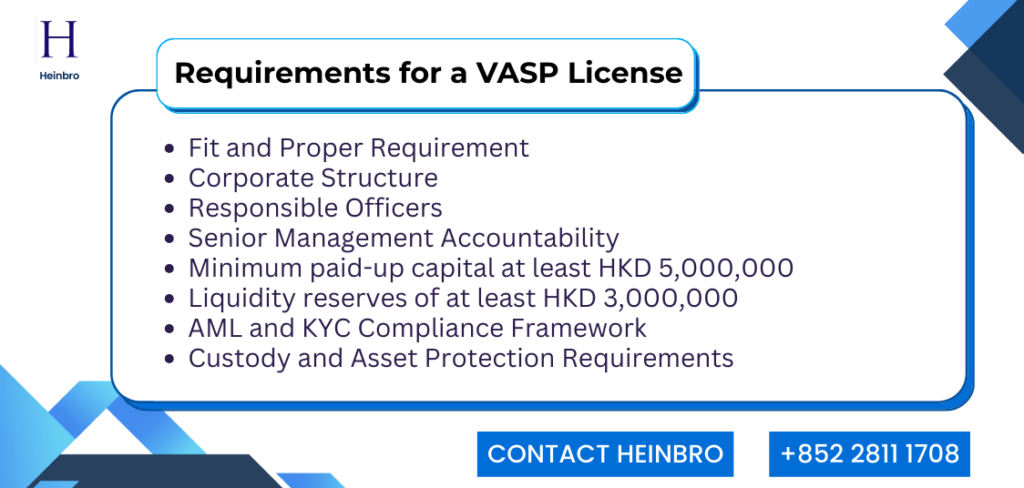
The SFC applies strict approval criteria before granting a license. Applicants must demonstrate they are “fit and proper” and capable of operating a secure and compliant trading platform.
Fit and Proper Requirement
All applicants—including the platform operator, responsible officers, and licensed representatives—must satisfy the fit and proper test.
The SFC evaluates factors such as:
- Integrity and reputation
- Competence and professional experience
- Financial soundness
- Ability to comply with regulatory requirements
The regulator will also assess substantial shareholders and ultimate beneficial owners of the applicant company.
Corporate Structure and Governance
Applicants must be a company incorporated in Hong Kong or an overseas company registered with the Companies Registry of Hong Kong.
Key requirements include:
- Appointment of Responsible Officers (ROs) approved by the SFC
- Clear board governance structure
- Defined risk management framework
- Adequate operational and compliance personnel
The SFC expects applicants to demonstrate strong corporate governance and internal control systems.
Senior Management Accountability
The SFC places strong emphasis on senior management accountability for licensed platform operators. Senior management generally includes directors, Responsible Officers, and Managers-in-Charge (MICs) of core functions, and these roles may overlap.
Applicants must provide the SFC with details of their MICs and organisational structure, which must be approved by the board of directors. Each MIC must acknowledge responsibility for their designated core functions.
After licensing, any changes to MIC appointments must be reported to the SFC within 7 business days.
Capital and Financial Resources
Applicants must maintain sufficient financial resources to support ongoing operations and manage risks.
Regulators typically assess:
- Minimum paid-up capital at least HKD 5,000,000
- Liquidity reserves of at least HKD 3,000,000
- Financial sustainability
- Insurance arrangements for operational risks
In addition to minimum capital requirements, the platform operator must maintain sufficient liquid assets to sustain operations, equal to at least 12 months of operating expenses, such as cash or bank deposits. Also, applicants must submit a 12-month operating expense projection when applying.
AML and KYC Compliance Framework
One of the most critical aspects of VASP licensing is anti-money laundering (AML) compliance.
Licensed platforms must implement:
- Customer Due Diligence (CDD)
- Enhanced Due Diligence (EDD) for high-risk clients
- Transaction monitoring systems
- Suspicious transaction reporting procedures
- Compliance with the FATF Travel Rule
These measures ensure that virtual asset transactions do not facilitate financial crime.
Custody and Asset Protection Requirements
Hong Kong regulators impose strict requirements on how digital assets are stored and safeguarded.
A platform operator must hold client assets through an Associated Entity that:
- Is incorporated in Hong Kong
- Is a wholly owned subsidiary of the platform operator
- Holds a TCSP license
- Only conducts the business of holding client assets on trust
Crypto exchanges must demonstrate that their custody architecture can prevent theft, loss, or unauthorized access.
Step-by-Step Guide to Applying for a Hong Kong VASP License
From a compliance advisory perspective, successful applicants usually follow a structured preparation process.
Step 1: Establish a Hong Kong Legal Entity
Before applying for a license, companies should establish a Hong Kong incorporated entity that will operate the virtual asset trading platform.
This step typically includes:
- Company incorporation
- Corporate governance setup
- Appointment of directors and senior management
- Establishment of compliance and risk management functions
Step 2: Build a Regulatory-Compliant Operating Framework
A common reason for licensing delays is inadequate operational preparation.
Applicants should establish:
- AML/KYC policies and procedures
- Cybersecurity architecture
- Custody and wallet management systems
- Risk management framework
- Compliance monitoring systems
In practice, regulators expect the platform to be operationally ready before submitting the license application.
Step 3: Prepare the SFC Licensing Documentation
The VASP license application requires extensive documentation, including:
- Detailed business plan
- Technology architecture description
- Compliance manuals
- Risk management policies
- AML procedures
- Organizational structure
- Financial projections
This documentation demonstrates to regulators that the applicant can operate in a safe and compliant manner.
Step 4: Regulatory Review and SFC Assessment
After submission, the SFC conducts a comprehensive review of the application.
The regulator evaluates:
- Technology infrastructure
- Security architecture
- Compliance policies
- Corporate governance
- Operational readiness
The review process often includes multiple rounds of regulatory questions and clarifications.
Step 5: Licensing Approval and Operational Launch
If the SFC is satisfied that the applicant meets all regulatory requirements, the platform operator will be approved to operate as a licensed Virtual Asset Trading Platform (VATP) and will be listed in the SFC public register of virtual asset trading platforms.
However, licensing also triggers ongoing regulatory obligations that must be carefully managed.
Ongoing Compliance Obligations for Licensed VASPs
Licensing is only the beginning of regulatory compliance. Licensed VATP operators must meet ongoing obligations.
1. Maintaining Responsible Officers
Licensed platforms must ensure that Responsible Officers (ROs) remain in place to supervise regulated activities. If an RO leaves the company or changes role, the platform must notify the SFC and ensure that proper supervision of the regulated activities continues.
2. Notification Requirements
Platform operators and licensed individuals must notify the SFC of significant changes, including:
- Changes to directors
- Changes to substantial shareholders
- Changes to ultimate beneficial owners
- Business cessation
- Changes in corporate structure
These notification requirements help ensure regulatory transparency and ongoing supervision.
3. Financial Reporting Requirements
Licensed platforms must submit regular financial reports to the regulator, including:
- Audited accounts
- Financial resources returns
- Annual returns
These reports enable the SFC to monitor the financial stability and compliance of licensed entities.
4. Payment of Annual Fees
Licensed platform operators must pay annual licensing fees to maintain their regulatory authorization. Failure to pay the required fees may result in regulatory enforcement actions.
5. Continuous Professional Training
Licensed representatives and Responsible Officers must complete Continuous Professional Training (CPT) to maintain their professional competence and stay updated on regulatory requirements.
Challenges When Applying for a Hong Kong VASP License
Complex Regulatory Expectations
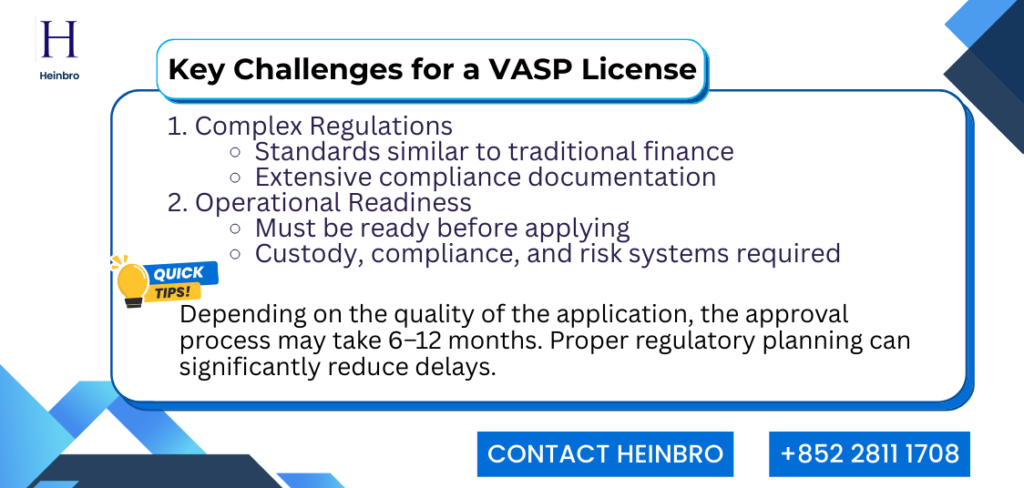
The licensing regime applies standards similar to those in traditional financial markets.
Crypto startups often underestimate the level of regulatory documentation required.
High Operational Readiness Requirements
Applicants must demonstrate operational readiness before licensing, including:
- custody infrastructure
- compliance systems
- risk controls
This requires significant preparation and investment.
Lengthy Licensing Process
Depending on the quality of the application, the approval process may take 6–12 months or longer. Proper regulatory planning can significantly reduce delays.
Successfully Obtaining a Hong Kong VASP License
Obtaining a Hong Kong VASP license is an essential step for crypto exchanges and digital asset platforms seeking to operate within one of the world’s most reputable financial jurisdictions. While the regulatory framework is robust and demanding, a well-prepared application and strong compliance infrastructure can significantly improve the chances of approval.
Heinbro combines deep regulatory expertise with hands-on operational support for financial services firms covering company establishment, licensing applications, compliance management, regulatory inspections, training, and talent resourcing.
With professional guidance and a strategic compliance approach, crypto businesses can successfully obtain a Hong Kong VASP license and establish a trusted presence in the rapidly evolving Web3 ecosystem. Contact Heinbro at heinbro@heinbro.com or +852 2811 1708 for a free consultation.