Hong Kong Work and Entrepreneur Visa Pathways in Finance Sector
Hong Kong continues to serve as a premier international financial centre, attracting global banks, asset managers, hedge funds, and fintech firms. For finance professionals and institutions entering this market, selecting the appropriate working visa—whether under the General Employment Policy (GEP), Top Talent Pass Scheme (TTPS), or Entrepreneur Visa—is a critical legal and operational decision. This guide provides a structured, compliance-focused Hong Kong work visa guide tailored to regulated financial businesses.
Hong Kong Work Visa Options for the Finance Sector
Hong Kong’s position as a gateway to Asia’s capital markets, combined with its robust regulatory framework under the Securities and Futures Commission (SFC) and Hong Kong Monetary Authority (HKMA), creates sustained demand for highly skilled finance professionals.
Key drivers include:
- Growth in asset and wealth management (including family offices)
- Expansion of fintech and virtual asset services
- Increasing regulatory and compliance requirements
- Cross-border financial connectivity with Mainland China
Hong Kong Work Visa Pathways
Finance professionals and firms typically rely on three primary visa routes:
- General Employment Policy (GEP) – employer-sponsored professionals
- Top Talent Pass Scheme (TTPS) – high-income or top-tier graduates
- Entrepreneur Visa – business founders and expansion cases
General Employment Policy (GEP) for Finance Professionals
What is GEP in the Finance Sector Context
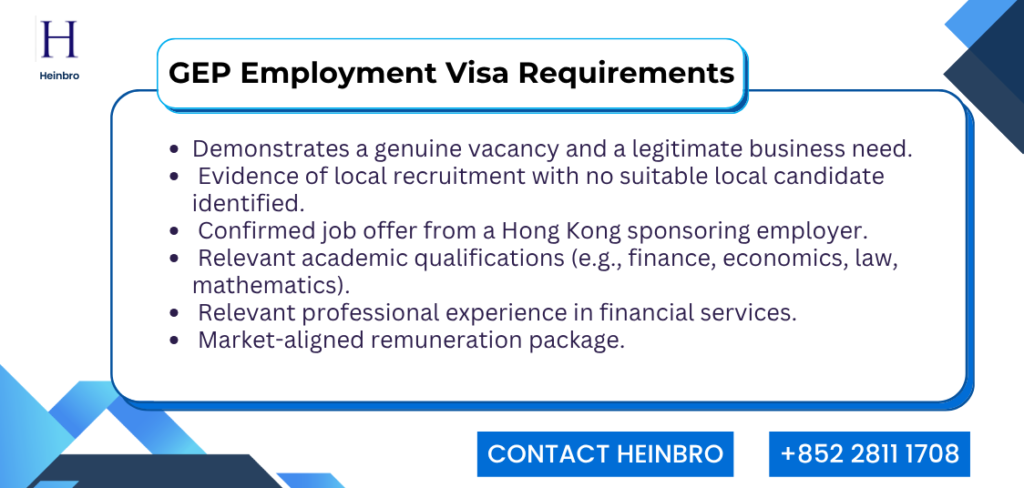
The GEP is the most commonly used work visa route for licensed financial institutions. It enables firms to sponsor overseas professionals where local talent is insufficient.
This route is particularly relevant for SFC-licensed corporations and regulated entities seeking to fill specialized roles.
GEP Eligibility Requirements
Common Finance Roles Approved Under GEP
Typical roles include:
- Responsible Officers (ROs) for SFC-regulated activities
- Compliance Officers and MLROs
- Portfolio Managers and Investment Analysts
- Risk, Quantitative, and Trading Specialists
GEP Compliance Considerations for Licensed Corporations
From a regulatory standpoint, firms must ensure:
- Alignment between the visa application and SFC licensing scope
- Clear organizational structure and reporting lines
- The candidate meets “Fit and Proper” standards
- Consistency across immigration and regulatory submissions
Top Talent Pass Scheme (TTPS) for High-Income Finance Professionals
What is TTPS and How It Applies to Finance Talent
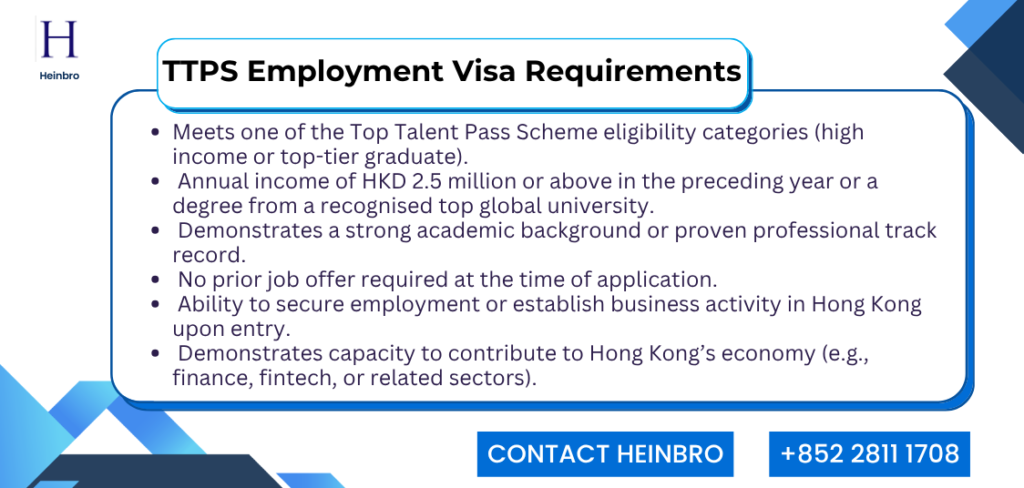
The TTPS is a fast-track immigration scheme designed to attract high-calibre individuals. Unlike GEP, it does not require a job offer at the initial application stage, making it particularly attractive for senior finance professionals.
TTPS Eligibility Criteria
Advantages of TTPS for Finance Executives
- No employer sponsorship required initially
- Flexibility to change employers within Hong Kong
- Faster processing timelines
- Suitable for senior executives, fund managers, and fintech leaders
Limitations and Compliance Risks
- Applicants must secure employment or establish economic activity for renewal
- Increased scrutiny on the genuineness of employment
- Not a substitute for regulatory licensing where required
Entrepreneur Visa for Finance Business Owners
When Finance Professionals Should Consider Entrepreneur Visa
This route is appropriate for:
- Establishing asset management firms or family offices
- Launching fintech or virtual asset platforms
- Expanding overseas financial institutions into Hong Kong
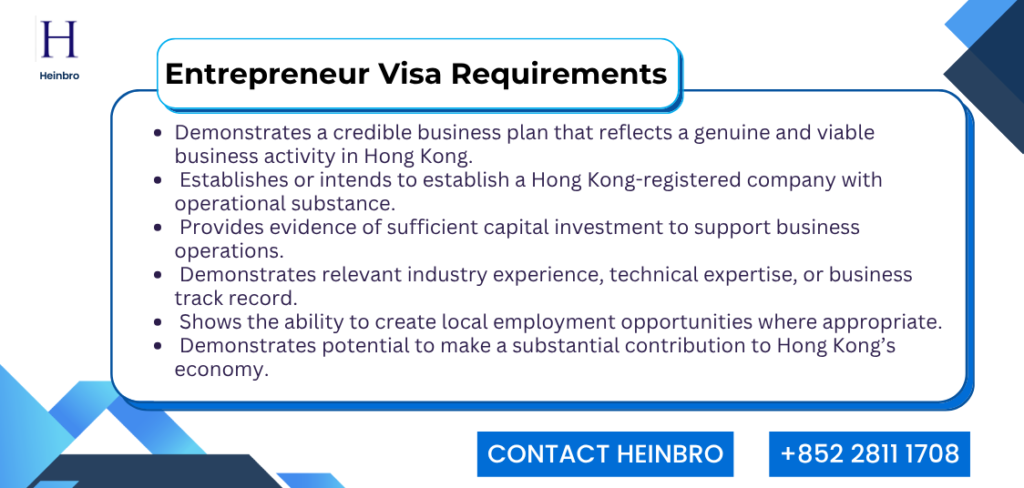
Financial Sector Entrepreneur Visa Requirements
Regulatory Considerations (SFC & HKMA)
Finance businesses are subject to additional scrutiny due to licensing requirements:
- SFC licenses for regulated activities
- Appointment and approval of Responsible Officers
- Implementation of compliance and risk frameworks
- Ongoing reporting and audit obligations
GEP vs TTPS vs Entrepreneur Visa: Key Differences for Finance Sector
|
Criteria
|
GEP
|
TTPS
|
Entrepreneur Visa
|
|---|---|---|---|
|
Sponsorship
|
Employer-sponsored
|
Not required initially
|
Self-sponsored
|
|
Target Users
|
Mid-level professionals
|
Senior/high-income talent
|
Business owners
|
|
Flexibility
|
Limited
|
High
|
Moderate
|
|
Regulatory Complexity
|
Moderate
|
Low
|
High
|
|
Best Use Case
|
Hiring staff
|
Attracting top talent
|
Business setup
|
Application Strategy for Finance Firms and Professionals
In practice, visa selection for the Hong Kong finance sector should not be treated as a standalone HR decision. It is closely tied to licensing strategy, regulatory timelines, and the firm’s operational substance.
Start with Licensing, Not Immigration
For regulated activities (e.g. asset management, dealing in securities, advisory), immigration strategy should follow—not precede—your licensing plan.
For example:
- If a firm intends to conduct Type 9 (asset management) activities, the availability of a Responsible Officer (RO) is critical. Submitting a GEP application before confirming the RO’s eligibility under SFC requirements often results in misalignment between regulators.
- Where the candidate will serve as an RO, their experience, licensing status, and reporting line should already be mapped out before the visa filing.
A practical approach is to prepare parallel submissions—ensuring consistency between Immigration Department filings and SFC applications.
Match the Visa Route to the Hiring Objective
Each visa route serves a distinct commercial purpose. Misuse or over-reliance on a single route is a common issue.
- GEP works best for structured hires where the role, reporting line, and business function are clearly defined. It is the default route for compliance officers, analysts, and licensed staff.
- TTPS is more suitable for senior hires who may enter Hong Kong before finalising employment. However, firms should avoid using TTPS to bypass proper sponsorship where a clear employer-employee relationship already exists.
- Entrepreneur Visa should be reserved for genuine business build-outs—such as establishing a licensed entity or expanding a foreign financial institution. It is not appropriate for quasi-employment arrangements.
A useful rule: if the individual’s role can be described within an organisational chart, GEP is usually the appropriate starting point.
Evidence the Commercial Rationale Clearly
The Immigration Department will look beyond job titles. In finance, many roles appear similar on paper, so differentiation is essential.
Stronger applications typically include:
- A specific explanation of strategy (e.g. expansion into private credit, virtual assets, or cross-border wealth management)
- How the candidate’s experience directly supports that strategy
- Why equivalent expertise is not readily available in the local market
For regulated firms, it is also helpful to show how the role supports regulatory obligations, such as compliance oversight, risk management, or licensing conditions.
Align Internal Documentation Across Functions
Inconsistent information across documents is a frequent trigger for follow-up queries.
Ensure alignment between:
- Employment contracts and job descriptions
- Business plans and licensing scope
- Organisational charts and actual reporting lines
- Immigration filings and SFC submissions
For instance, if a candidate is described as a “portfolio manager” in a visa application but appears as a “research analyst” in licensing documents, this discrepancy will likely require explanation.
Plan for Substance, Not Just Approval
Approval is only the first step. Both Immigration and financial regulators increasingly focus on ongoing substance.
Firms should be prepared to demonstrate:
- Active business operations in Hong Kong
- Local staffing (particularly in compliance and control functions)
- Physical office presence where required
- Actual revenue-generating or regulated activities
This is particularly important for Entrepreneur Visa cases, where business plans must translate into actual operations within a reasonable timeframe.
Build in Realistic Timelines
Visa processing timelines (typically 4–8 weeks for GEP) should be considered alongside:
- SFC licensing timelines (which can be longer and iterative)
- Hiring start dates and onboarding plans
- Internal governance approvals
Rushed applications—especially those submitted before key elements are ready—often result in longer overall timelines due to regulatory queries.
When to Seek External Support
Certain scenarios—such as Responsible Officer (RO) appointments, multi-entity group structures, cross-border secondments, and fintech or virtual asset businesses—go beyond standard visa applications. These cases typically involve overlapping immigration, licensing, and regulatory considerations that must be addressed in a coordinated manner.
For complex or high-stakes cases, it is advisable to contact Heinbro directly for coordinated support. With experience across visa applications, SFC licensing, and ongoing compliance, Heinbro supports firms in structuring applications that are both approvable and operationally sustainable within Hong Kong’s regulatory framework.

Compliance and Post-Approval Obligations
Securing a visa approval is only the starting point. In Hong Kong’s finance sector, immigration status is closely tied to ongoing regulatory compliance and actual business activity. Both the Immigration Department and financial regulators will expect to see that the original basis of approval continues to hold in practice.
Maintaining Visa Validity in Practice
Visa conditions are not static. They must be supported by real, ongoing substance.
For Employment Visa (GEP) holders, this means:
- Remaining employed in the same role, entity, and capacity as approved
- Avoiding unreported changes in job title, responsibilities, or reporting lines
- Ensuring remuneration remains broadly consistent with market levels
For Entrepreneur Visa holders, expectations are higher. Authorities will typically look for:
- Active business operations (not a dormant or shell entity)
- Actual revenue-generating activities or demonstrable client engagement
- Local hiring, particularly in control functions such as compliance
Any material change—such as restructuring, change of employer, or significant shift in business model—should be assessed in advance. In many cases, a fresh application or formal notification to the Immigration Department is required.
Renewal Is a Substantive Review
Visa renewals are increasingly treated as a fresh assessment of credibility and activity, rather than a procedural extension.
In practice, applicants should be prepared to demonstrate:
- Continuous employment or business activity over the relevant period
- Financial performance (for businesses) or employer stability
- Contribution to the Hong Kong market (e.g. projects, clients, AUM growth)
For finance professionals, inconsistencies between visa records and actual job functions—especially in regulated roles—can create complications at renewal stage.
Alignment with SFC Regulatory Expectations
For SFC-licensed corporations, immigration compliance cannot be separated from licensing obligations.
Firms should ensure:
- Individuals performing regulated functions hold the appropriate SFC licences
- Responsible Officers remain actively engaged and properly supervised
- Staffing levels are adequate to support the licensed activities
A common issue arises where a visa holder is approved for a role that does not fully align with their licensed responsibilities. This disconnect may trigger questions from both the SFC and Immigration Department.
Internal Controls, Governance, and Audit Trail
From a supervisory perspective, regulators expect firms to maintain proper internal governance around staffing and operations.
This includes:
- Clear organisational structure and reporting lines
- Documented job descriptions and employment terms
- Internal records evidencing actual duties performed
Firms should also maintain an audit trail of key decisions—such as hiring justifications, role changes, and reporting updates—particularly where overseas staff are involved.
Preparing for Inspections and Regulatory Enquiries
Both the Immigration Department and the SFC may raise queries or conduct reviews, especially in higher-risk sectors such as asset management and virtual assets.
Practical steps include:
- Ensuring consistency across immigration filings, licensing records, and internal documents
- Being able to explain the commercial rationale behind each overseas hire
- Keeping business plans and financial projections updated and supportable
For Entrepreneur Visa cases, regulators may test whether the business has delivered on its original commitments—such as hiring plans or market entry strategy.
Building a Compliant Market Entry Strategy: Visas, Licensing, and Beyond
A well-structured approach integrates immigration, licensing, and business substance from the outset, ensuring that applications are not only approved but remain sustainable under review. This is especially critical for regulated activities, where staffing, governance, and regulatory expectations must remain consistent over time.
Heinbro supports financial services firms across the full lifecycle of market entry and expansion in Hong Kong. From visa strategy and SFC licensing, to ongoing compliance, inspection support, and talent resourcing, Heinbro provides a coordinated, one-stop solution. By combining regulatory expertise with practical execution, Heinbro helps firms establish, operate, and grow in Hong Kong with confidence and full compliance. For assistance, email Heinbro at heinbro@heinbro.com or arrange a free consultation by calling +852 2811 1708.