
Hong Kong SFC License Guide for Financial Startups
If you are building a fintech, asset management, investment, or crypto-related startup in Hong Kong, SFC licensing is not a “later-stage problem.” It is a structural requirement that affects your product design, hiring, fundraising, and even whether you can legally operate.
This guide explains SFC licensing in Hong Kong clearly, accurately, and practically—from a startup and growth-stage business perspective. We’ll help you understand which SFC license you need, why it’s required, how long the SFC licensing process takes, and how to avoid costly compliance mistakes.
What Is SFC Licensing and Why It Matters for Startups?
The Securities and Futures Commission (SFC) regulates businesses that:
- Manage assets
- Deal in securities or futures
- Provide investment advice
- Operate collective investment schemes
- Handle or control client assets
For startups, the most common mistake is assuming that:
- being early-stage,
- being offshore, or
- calling yourself “technology-first”
means licensing can wait. It usually cannot.
If your business model involves regulated activities, SFC licensing is required before you operate, not after traction.
Who Actually Needs an SFC License?
You are likely required to obtain SFC licensing in Hong Kong if your startup:
- Manages third-party money
- Makes discretionary investment decisions
- Provides investment advice to clients
- Distributes funds or investment products
- Targets Hong Kong investors, even from overseas
You may not require licensing if:
- You manage only your own proprietary assets
- You provide services exclusively within a wholly owned group
- Your activities fall squarely within specific statutory exemptions
These exemptions are narrowly interpreted by the SFC. Misunderstanding them is a common cause of enforcement issues.
2. Segregated Portfolio Company (SPC)
A Segregated Portfolio Company (SPC) is a specialized offshore fund structure, most commonly established under the Cayman Islands SPC regime, and is particularly popular among hedge fund platforms and multi-strategy managers.
An SPC is a single legal entity that may create multiple segregated portfolios, each of which is legally ring-fenced from the others. Key legal characteristics include:
- Statutory segregation of assets and liabilities
- Creditors of one portfolio have no recourse to other portfolios
- Centralized governance with portfolio-level accounting
From a practical standpoint, the segregated portfolio company fund structure allows investors to allocate capital to specific strategies, geographies, or asset classes within the same legal vehicle, improving operational efficiency and cost management.
SFC Regulated Activities Explained (Types Startups Actually Need)
There are 13 SFC regulated activities, but startups usually deal with just three.
Type 1 – Dealing in Securities
You need a Type 1 license if your startup:
- Executes securities transactions
- Distributes funds
- Operates a brokerage or platform facilitating trades
This license is common for fintech platforms, fund distributors, and investment marketplaces.
Type 4 – Advising on Securities
You need a Type 4 license if your startup:
- Provides investment recommendations
- Publishes research or model portfolios
- Advises clients on securities, even without execution
Advice alone can trigger licensing, even if no money changes hands.
Type 9 – Asset Management
You need a Type 9 license if your startup:
- Manages portfolios
- Operates investment funds
- Exercises discretion over client assets
This is the most common license for asset managers, fund managers, and many crypto-related businesses.
Crypto & Web3 note: Many virtual asset businesses still fall under Type 1, 4, or 9, plus additional SFC VA requirements.
SFC Licensing Requirements (What the SFC Actually Cares About)
1. Responsible Officers (ROs)
Every licensed company must appoint at least two Responsible Officers per regulated activity.
ROs must:
- Have relevant industry experience
- Understand Hong Kong regulation
- Be actively involved in the business
At least one RO must be an executive director, and at least one must be available to supervise the business at all times.
Weak or unsuitable RO candidates are one of the most frequent causes of delayed or rejected applications.
2. Capital Requirements
Capital requirements depend on the regulated activity. For Type 9 (Asset Management):
- If you do not hold client assets:
- Minimum liquid capital: HK$100,000
- If you do hold client assets:
- Minimum paid-up capital: HK$5,000,000
- Minimum liquid capital: HK$3,000,000
These levels must be maintained continuously, not just at the time of application.
3. Compliance Systems and Internal Controls
The SFC expects licensed startups to demonstrate:
- Effective AML and KYC procedures
- Risk management frameworks
- Internal controls tailored to the business model
Generic or copy-pasted compliance manuals are easily identified and often lead to follow-up questions or delays.
The SFC Licensing Application Process
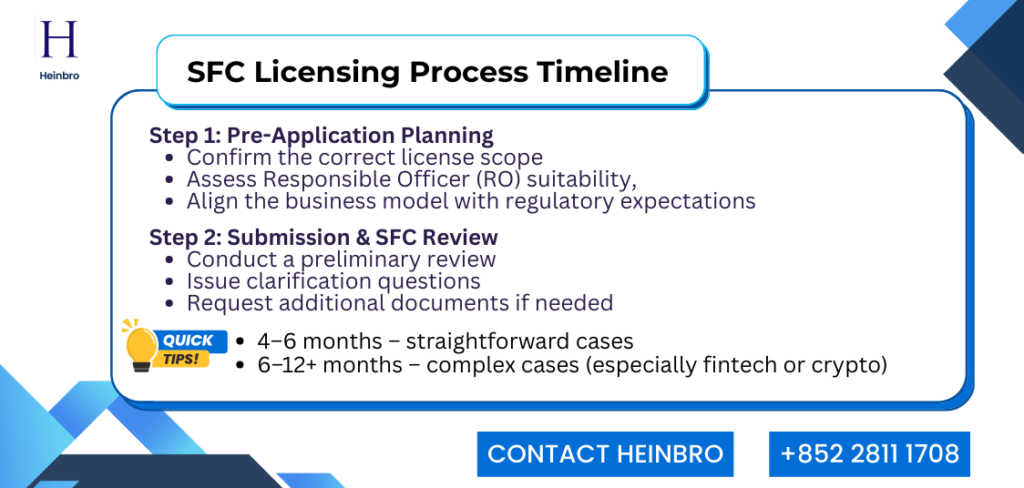
Step 1: Pre-Application Planning
This is the most important stage and includes:
- Confirming the correct license scope
- Assessing RO suitability
- Aligning the business model with regulatory expectations
Errors made here can add months to the timeline.
Step 2: Submission & Review
After submission, the SFC will:
- Conduct a preliminary review
- Issue clarification questions
- Request additional documents where necessary
The statutory performance pledge is 15 weeks after formal acceptance, but this does not include preparation time or follow-up rounds.
Step 3: Approval
In practice:
- Straightforward cases take 4–6 months
- Complex cases (especially fintech or crypto) take 6–12 months or longer
The SFC prioritises accuracy over speed.
Ongoing Compliance After You Are Licensed
SFC licensing is not a one-time exercise.
Licensed startups must:
- Maintain capital requirements at all times
- Submit annual returns
- Track continuous professional training (CPT)
- Notify the SFC of changes to ROs, MICs, shareholders, or business scope
Compliance should be treated as a permanent operating cost, not a project.
Is SFC Licensing Worth It for Startups?
While the process is demanding, SFC licensing offers:
- Regulatory legitimacy
- Improved banking access
- Institutional investor confidence
- Long-term scalability in Hong Kong and beyond
For many startups, it becomes a strategic asset, not just a compliance requirement.
Do You Actually Need SFC Licensing?
Ask yourself:
- Are we touching client assets?
- Are we making investment decisions?
- Are we marketing to Hong Kong investors?
If the answer is “yes” to any of the above, SFC licensing is likely unavoidable.
SFC Licensing Made Easier with Heinbro

For startups, SFC licensing in Hong Kong is:
- A barrier to entry (good)
- A credibility signal (very good)
- A growth enabler (if done right)
Get it right early, and you unlock institutional clients, banking relationships, and long-term scalability.
Get it wrong, and you’ll be rebuilding under regulatory pressure.
Not sure which SFC license applies to your startup? A short scoping discussion can save months of delays and unnecessary costs. Contact Heinbro via heinbro@heinbro.com or book a free consultation by calling +852 2811 1708 .