



Is your BVI company fully compliant with the latest regulatory requirements? In recent years, global transparency standards driven by the OECD, EU, and FATF have significantly reshaped the compliance landscape in the British Virgin Islands (BVI). Directors and shareholders can no longer treat offshore structures as “set and forget.” Failure to comply with the BVI Business Companies Act, annual return obligations, or BVI economic substance legislation may lead to penalties, strike-off, or reputational damage. This guide provides a practical, legally grounded roadmap to staying compliant with the BVI Company Registry.
Key Compliance Obligations Under the BVI Companies Act
The BVI Company Registry, formally known as the Registry of Corporate Affairs, operates under the BVI Financial Services Commission (FSC). It administers the BVI Business Companies Act, 2004 (as amended) and maintains the official register of companies incorporated in the Territory.
Recent amendments to the BVI Business Companies Act (BCA) and related legislation, effective between 2023 and 2025, have significantly strengthened corporate transparency, governance standards, and statutory filing obligations. These reforms include revised mechanisms governing the dissolution and reinstatement of companies struck off the BVI Register of Companies, as well as expanded regulatory reporting and disclosure requirements. Collectively, the amendments align BVI companies more closely with evolving international regulatory expectations and global transparency standards.
1. Register of Members (ROM) – Mandatory Filing Requirement
New Filing Obligation (Effective 2 January 2025)
All BVI Business Companies are now required to file a copy of their Register of Members (ROM) with the BVI Registrar of Companies.
- New companies / companies continuing into the BVI:
Must file the initial ROM within 30 days of incorporation or continuation. - Existing companies incorporated before 2 January 2025:
Must comply within six months from the effective date (by 2 July 2025). - Subsequent changes:
Any amendments to the filed register must be notified to the Registrar within 30 days of the change.
Nominee Shareholder Disclosure
The filed ROM must include detailed information relating to nominee arrangements, including:
- Name and address of the nominator
- Date the nominee ceased to be a member (if applicable)
- Date a person ceased to be a nominator
This reform materially increases transparency regarding ultimate ownership structures.
2. Register of Directors (ROD) – Enhanced Governance Controls
Appointment of First Directors
The timeframe for appointing the first director(s) has been significantly reduced:
- Old regime: Within 6 months of incorporation
- New regime: Within 15 days of incorporation
This change ensures that companies establish formal governance oversight immediately upon formation.
Professional Director Services – Additional Disclosure
Where a company appoints an FSC-licensed director under the Banks and Trust Companies Act (BTCA) or the Securities and Investment Business Act (SIBA) (the “Licensee”), additional information must be filed with the Registrar when submitting the Register of Directors.
The filing must confirm:
- Whether the Licensee acts as a corporate director or as an individual representative
- The name of the Licensee
- The name and address of the individual representing the Licensee (if applicable)
Existing companies must comply with this requirement within six months of the effective date.
Rectification of Register of Directors
The Amendment Act introduces a formal mechanism allowing inaccuracies or omissions in the Register of Directors to be rectified through court application. This provides legal certainty while reinforcing the importance of accurate filings.
3. Beneficial Ownership (BO) – Direct Filing with the Registrar
Revised Definition and Filing Process
The Amendment Act clarifies that a Beneficial Owner (BO) must be a natural person who ultimately owns or controls the company.
Companies must now file beneficial ownership information directly with the Registrar of Corporate Affairs (ROCA) within:
- 30 days of incorporation or continuation, or
- 30 days of any change in BO information
This replaces the previous filing system via the BOSS Portal.
Exemptions
Certain entities are exempt from filing BO information directly with ROCA, including:
- Companies listed on a recognized stock exchange
- Regulated BVI funds where BO information is held by:
- A Category 6 licensee under SIBA, or
- An authorized representative or licensed person with a physical presence in the BVI who can provide BO information within 24 hours upon request
Registered Agents remain responsible for verifying and updating BO information within statutory timelines.
Existing companies must comply with the revised BO regime within six months of the effective date.
4. Continuation Under Foreign Law (Outbound Redomiciliation)
Where a BVI company intends to continue under foreign law, directors must now submit an expanded compliance declaration to the Registrar confirming:
- Compliance with information requests from competent authorities
- No receiver has been appointed over the company or its assets
- The company is not aware of pending legal proceedings involving the company or its stakeholders
This enhances regulatory oversight and protects creditor and stakeholder interests during redomiciliation.
5. Certificates of Good Standing – Stricter Conditions
To obtain a Certificate of Good Standing, companies must now ensure:
- All government fees and penalties are fully paid
- Register of Members has been filed
- Register of Directors has been filed
- Register of Beneficial Owners has been filed
- No notice has been received from the Registered Agent indicating non-submission of the Annual Financial Return (AFR)
Currently, certificates may still be issued with annotations such as:
- “No Beneficial Owners register filed”
- “No register of members filed”
However, it is expected that from 2 July 2025 onward, certificates will not be issued where required filings remain outstanding.
6. Mandatory Annual Financial Return (AFR)
Effective 1 January 2023, most BVI companies are required to submit an Annual Financial Return (AFR) to their Registered Agent within nine months after the end of their financial year. The AFR consists of a summary balance sheet and a summary profit and loss statement, providing a high-level overview of the company’s financial position. While standard BVI Business Companies are not subject to a statutory audit requirement, entities regulated by the BVI Financial Services Commission (FSC) must submit audited financial statements in accordance with applicable regulatory standards.
Certain entities are exempt from the AFR obligation including listed companies, specified regulated entities, and companies that file tax returns with the BVI Inland Revenue. Importantly, failure to submit the AFR within the prescribed timeframe may adversely affect the company’s Good Standing status and trigger compliance consequences.
7. Statutory Record-Keeping Obligations
Under Section 98 of the BCA:
- Companies must maintain records sufficient to explain transactions and determine financial position at any time.
- Records must be retained for at least five years.
- Records may be kept anywhere globally, but the Registered Agent must be informed of the physical location.
8. Economic Substance (ES) Requirements
Companies conducting “relevant activities” (e.g., finance and leasing, headquarters, IP business, shipping, banking) must:
- Demonstrate adequate economic substance in the BVI
- Conduct core income-generating activities (CIGA) in the Territory
- File an annual ES report with the International Tax Authority (ITA) via the Registered Agent within six months of the end of the financial period
Non-compliance may result in significant penalties and information exchange with foreign tax authorities.
9. Governance & Administrative Obligations
To remain compliant under the BVI Companies Act, companies must:
- Maintain a licensed Registered Agent and registered office in the BVI at all times
- Appoint first directors within 15 days of incorporation
- Update statutory registers within 30 days of changes
- Pay annual government fees to maintain Good Standing
10. Strike-Off, Dissolution and Reinstatement – Revised Regime
Recent amendments to the BVI Business Companies Act have fundamentally altered the consequences of strike-off, making dissolution quicker and reinstatement significantly more restrictive.
|
Issue
|
Previous Regime
|
Current Regime
|
|---|---|---|
|
Status after strike-off
|
Suspended for up to 7 years
|
Automatically dissolved after 90 days’ notice
|
|
Reinstatement process
|
Administrative reinstatement upon payment of fees
|
Fast Track (within 5 years) if actively operating
|
|
If administrative route fails
|
Generally not applicable
|
Court restoration required
|
|
Pre-2023 struck-off companies
|
Could rely on prior regime
|
Automatically dissolved (1 July 2023); Court restoration required
|
|
Treatment of assets
|
No immediate vesting
|
Assets may vest in the Crown upon dissolution
|
11. New Requirements for Liquidators
The amendments introduce a residency requirement for company-appointed voluntary liquidators.
- A liquidator must have been physically resident in the BVI for at least 180 days prior to appointment.
- If more than one liquidator is appointed, only one must satisfy the residency requirement.
- This requirement applies only to liquidators appointed after 1 January 2023.
This reform strengthens local regulatory oversight in voluntary liquidation processes.
12. Abolishment of Bearer Shares
The Amendment Act has fully abolished bearer shares.
- As of 1 July 2023, all existing bearer shares were automatically converted into registered shares.
- Companies can no longer issue or maintain bearer shares.
Although bearer shares had already declined in practical use due to compliance costs and reputational concerns, their formal elimination reinforces the BVI’s commitment to ownership transparency and international regulatory standards.
What Is the BVI Annual Return (Annual Financial Return – AFR)?
Recent amendments to the BVI Business Companies Act introduced the requirement to submit an Annual Financial Return (AFR) to the registered agent.
Important clarifications:
- The AFR is not a public filing.
- It is submitted to the registered agent only.
- It contains basic financial information.
- An audit is generally not required (unless regulated activity applies).
The purpose is to enhance transparency and ensure compliance with international standards.
BVI Annual Return Filing Deadline
A BVI company must file its AFR within 9 months after the end of its financial year.
Failure to meet this deadline may result in:
- Progressive financial penalties
- Reporting to regulatory authorities
- Strike-off risk if persistent
Directors should diarize the financial year end and begin preparing financial summaries early.
What Must Be Included in the Annual Return?
The AFR typically includes:
- Summary balance sheet information
- Summary income statement information
- Confirmation of financial records
The level of detail is proportionate and not equivalent to full audited accounts.
BVI Economic Substance Legislation – Who Must Comply?
The BVI Economic Substance (Companies and Limited Partnerships) Act was introduced in response to the OECD’s Base Erosion and Profit Shifting (BEPS) initiative.
The legislation requires certain BVI entities conducting “relevant activities” to demonstrate adequate economic substance in the Territory.
Relevant Activities Triggering Economic Substance Requirements
A BVI company must assess whether it conducts:
- Holding business
- Finance and leasing business
- Headquarters business
- Distribution and service centre business
- Intellectual property business
- Fund management business
- Insurance or banking business
If engaged in a relevant activity, economic substance obligations apply.
Economic Substance Reporting Obligations
Companies conducting relevant activities must:
- Submit annual economic substance reports
- Demonstrate they are directed and managed in the BVI
- Maintain adequate employees or outsourcing arrangements
- Maintain adequate premises
- Conduct core income-generating activities (CIGA) in the BVI
For pure equity holding entities, reduced substance requirements may apply, but compliance is still mandatory.
Penalties for Economic Substance Non-Compliance
Non-compliance may result in:
- Substantial financial penalties
- Mandatory information exchange with foreign tax authorities
- Court-ordered remediation
- Strike-off
Repeat failures significantly increase enforcement risk.
Practical Compliance Checklist for BVI Companies

Practical Compliance Checklist for BVI Companies
Download your free BVI Compliance Checklist and ensure your company remains in good standing.
Strategic Compliance Approach for International Groups
For multinational structures using BVI holding or financing entities, coordination is critical.
Best practices include:
- Aligning BVI reporting timelines with Hong Kong or Singapore reporting cycles
- Integrating BVI compliance into group governance frameworks
- Conducting annual substance reviews
- Engaging cross-border compliance advisors
A structured compliance calendar significantly reduces exposure.
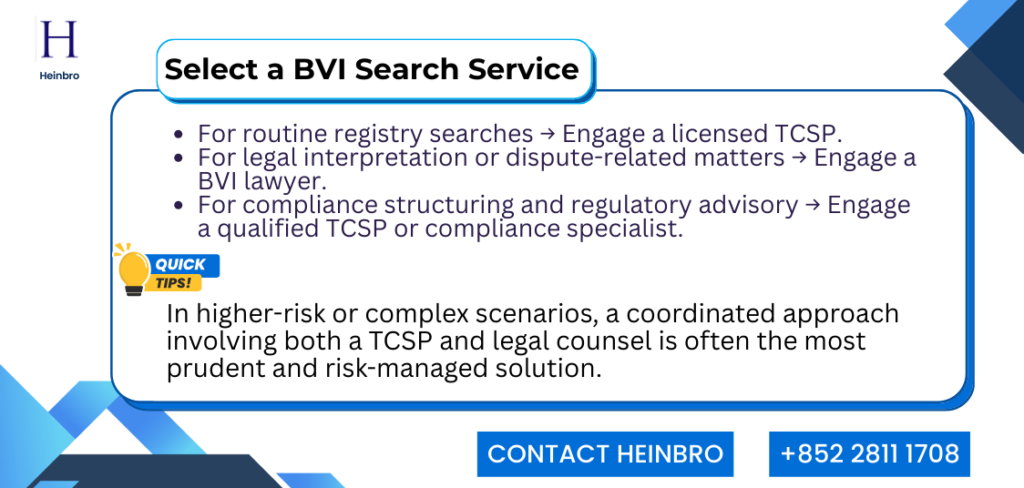
Should a BVI Search Be Conducted by a Lawyer or a TCSP?
When conducting a BVI company search, the appropriate professional to engage—whether a lawyer or a Trust and Corporate Service Provider (TCSP) / financial services consultant—depends largely on the purpose, risk profile, and complexity of the matter.
Routine Corporate Searches – TCSP Typically Sufficient
For standard corporate due diligence and transactional support, a licensed TCSP is generally sufficient. This typically includes obtaining:
- Company registry search reports
- Certificate of Incorporation
- Memorandum and Articles of Association
- Filed Register of Directors
- Certificate of Good Standing
- Confirmation of filing status
Licensed TCSPs regularly interact with the BVI Registry of Corporate Affairs and are well-positioned to obtain official corporate documents efficiently and cost-effectively. For transactional due diligence, onboarding procedures, or basic compliance checks, engaging a TCSP is typically appropriate.
Legal Risk or Dispute Context – Lawyer Recommended
A BVI lawyer should be engaged where the search is connected to legal risk or contentious matters, including:
- Litigation or enforcement proceedings
- Asset tracing or insolvency
- Shareholder or director disputes
- Court rectification of statutory registers
- Interpretation of the BVI Business Companies Act
- Complex nominee or beneficial ownership structures
In these situations, legal analysis, professional privilege, and strategic advice are critical. Lawyers provide interpretative and procedural guidance that extends beyond document retrieval.
Regulatory and Compliance Context – TCSP / Compliance Advisor
Where the objective relates to regulatory or structural compliance—such as:
- Economic substance classification and reporting
- Beneficial ownership compliance
- Regulatory inspections or investigations
- Cross-border structuring and governance alignment
A regulated financial services consultant or TCSP with offshore regulatory expertise may be appropriate, particularly where the focus is preventative compliance rather than litigation.
For firms operating from Hong Kong or using BVI structures within a broader regional framework, Heinbro, a TCSP-licensed legal compliance service provider in Hong Kong, offers integrated advisory support. Heinbro assists with BVI corporate searches, compliance assessments, economic substance reviews, and cross-border governance coordination, ensuring that registry information is properly interpreted within a broader regulatory context.
Staying Compliant with the BVI Company Registry
Compliance with the BVI Company Registry, the BVI Companies Act, BVI annual return (AFR) requirements, and BVI economic substance legislation is no longer optional—it is central to maintaining corporate good standing and protecting international business operations.
Directors who adopt a proactive, structured compliance approach can avoid penalties, prevent strike-off, and maintain global credibility.
For financial services firms operating in or through offshore structures, expert guidance is essential. Heinbro combines deep regulatory expertise with hands-on operational support for financial services firms, including advisory on BVI corporate compliance, economic substance assessments, cross-border governance structuring, and ongoing regulatory support. With practical experience in navigating complex offshore regulatory environments, Heinbro helps firms align their BVI compliance obligations with broader international governance strategies—ensuring stability, credibility, and long-term operational confidence. For any BVI-related consultations, please contact Heinbro at heinbro@heinbro.com or by phone at +852 2811 1708.