Why Asset Managers in Hong Kong Are Outsourcing Their Compliance Function
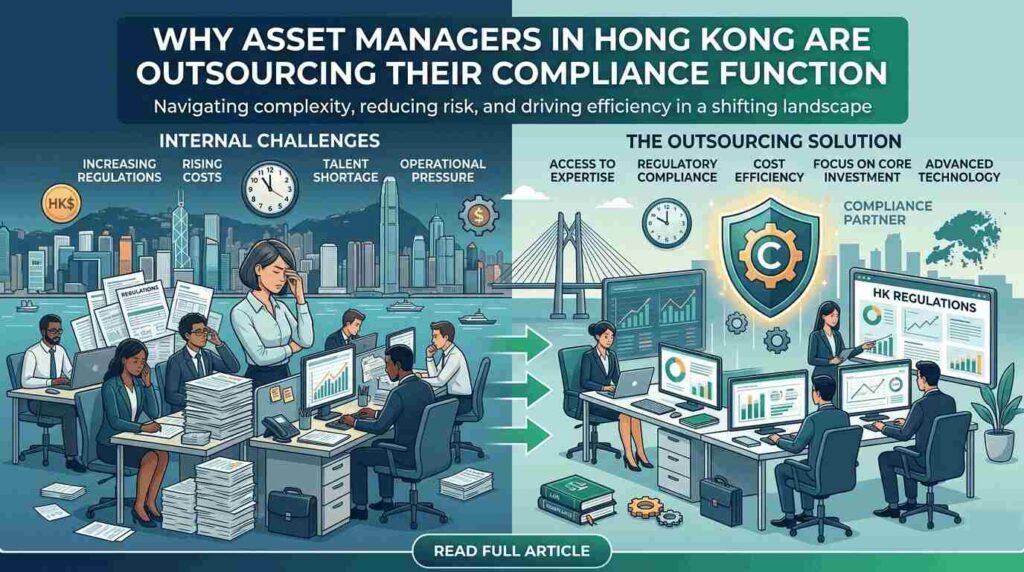
For asset managers in Hong Kong, compliance with the Securities and Futures Commission (SFC) has never been more demanding. Licensed corporations face increasing regulatory expectations, more frequent inspections and a heavier documentation burden, even where teams remain lean. For start‑ups and growing managers, maintaining a robust compliance function entirely in‑house can quickly become a material strain on budget and senior management time.
Against this backdrop, many firms are turning to outsourced compliance or ongoing regulatory support. Rather than building a full internal team from day one, they work with specialist advisers on a retainer basis to design, implement and operate their compliance framework. This model has become a mainstream solution for Hong Kong asset managers that want institutional‑grade controls without institutional‑level fixed costs.
What is an outsourced compliance function?
An outsourced compliance function is an arrangement under which an external specialist team supports or runs the day‑to‑day compliance activities of an SFC‑licensed firm. The relationship is typically structured as a retainer: the firm pays a predictable monthly fee in exchange for ongoing access to experienced compliance professionals.
In practice, the scope usually covers:
- Drafting and maintaining compliance manuals and procedures
- Designing compliance monitoring plans
- Review marketing, client and investor materials
- Assist in regulatory filings, notifications and returns
- Delivering staff training and ongoing compliance support
- Monitoring changes in SFC updates and new circulars
Outsourcing is also adaptable. Some managers rely on external support to operate almost the entire compliance function, particularly in the early stages before they can justify a full‑time staff. Others use an outsourced provider to supplement an existing in‑house legal or compliance officer, adding capacity and specialist knowledge without over‑expanding fixed headcount.
Outsourcing compliance benefits for asset managers
The most immediate advantage of outsourcing is access to deep, specialised expertise. A specialised compliance consultant spends every day working with a wide range of SFC‑licensed firms – from boutique asset managers and hedge funds to multi‑strategy platforms. That breadth of experience gives it visibility over how the regulator’s expectations are evolving in practice, not only as articulated in formal guidance. Asset managers can draw on this market‑wide insight when designing their own frameworks and responding to new regulatory developments.
Beyond expertise, managers typically see three core benefits:
Cost efficiency
Hiring a senior compliance professional in Hong Kong entails a significant salary, benefits, training and management oversight. For many start‑ups and smaller managers, that level of fixed cost is difficult to justify, particularly while assets under management are still building. Outsourcing the compliance function spreads expenditure over time and provides access to a team of specialists for a fraction of the cost of an equivalent internal department.
Flexibility and scalability
As a manager’s strategies, AUM and client base grow, the volume and complexity of compliance work will increase. An external provider can adjust the level of support accordingly – increasing monitoring coverage, assisting with new product approvals or enhancing reporting – without the firm needing to restructure its headcount.
Support for a strong compliance culture
Regular contact with experienced advisers, ongoing training and practical guidance on real‑life issues. Compliance is part of day‑to‑day business rather than an occasional project. For many firms, this external discipline helps embed good habits earlier in their development.
Why outsourcing suits Hong Kong start‑ups and growing firms
The outsourced model has become particularly common among early‑stage and growth‑stage asset managers in Hong Kong. These firms are often founder‑led, with portfolio managers or investment professionals also taking on senior management and Responsible Officer (RO) roles. While they recognise the importance of compliance, their primary focus must remain on investment performance and client relationships.
For such firms, outsourcing offers a way to meet SFC standards and investor expectations without building a large back‑office. In practical terms, an external compliance partner can:
- Design a pragmatic framework tailored to the firm’s strategies, trading style, investor base and operational set‑up
- Help implement procedures that work with, rather than against, existing workflows
- Monitor how the framework is operating in practice, flag gaps and recommend improvements, while the internal team concentrates on running the business
This support is particularly valuable when raising capital from sophisticated investors who are highly sensitive to operational and compliance risk. Having an identifiable, experienced compliance partner in place provides comfort that the firm takes its regulatory obligations seriously and has access to independent advice when needed.
How an outsourced compliance partner works in practice
A typical engagement begins with an initial gap analysis or diagnostic review. The external team assesses the firm’s existing policies, procedures and controls against SFC requirements and market practice, and speaks with senior management and ROs to understand the business model, risk profile and growth plans.
From there, the work usually follows a clear sequence:
Framework design or refinement – drafting or updating manuals, defining monitoring tests, setting up reporting templates and recommending any changes to governance structures.
Implementation support – assist in implementing procedures into day‑to‑day operations and clarifying responsibilities across different roles.
Ongoing monitoring and advisory – periodic reviews, regular compliance meetings, updates on regulatory changes and support with ad hoc questions or incidents.
Legal responsibility and accountability remain with the licensed corporation’s senior management and ROs. Outsourcing compliance support does not outsource responsibility. Instead, it gives management access to tools, experience and independent challenge that may be difficult to replicate internally at an early stage.
A strategic investment, not just a cost
For Hong Kong asset managers, particularly those at the start of their journey, outsourced compliance support is increasingly viewed as a strategic investment rather than a simple overhead. It enables firms to demonstrate to the SFC, investors and counterparties that they are serious about governance and risk management, while keeping their operating model lean and focused.
As regulatory expectations continue to evolve, managers that build a strong compliance foundation from day one will be better placed to scale sustainably. Partnering with the right outsourced compliance provider can be an efficient way to achieve this, combining cost efficiency with specialist insight and market perspective that many in‑house teams would otherwise find challenging to assemble.
Ready to talk for your compliance function?
If you are an SFC‑licensed asset manager in Hong Kong, or planning to become one, and you recognise that your internal resources are already stretched, it is worth exploring how outsourced compliance support could help. Heinbro Consulting Limited works with start‑ups and growing managers to design, implement and run pragmatic compliance frameworks that meet SFC expectations without creating unnecessary bureaucracy. Our team brings experience from supporting a wide range of licensed firms, giving you access to market‑wide insight that is difficult to replicate in‑house, especially in the early stages. If you would like to discuss how an outsourced compliance function might fit your business model, timelines and budget, we would be pleased to arrange a short, no‑obligation consultation. Please contact Heinbro at heinbro@heinbro.com or by phone at +852 2811 1708.